Agent Script 通用模式
本章提供使用 Agent Script 构建 Agent 的12 个通用模式。每个模式聚焦于一种特定技术,帮助你让 Agent 更可靠、更高效。所有模式均以 Script 视图格式编写,可直接复制粘贴到你的 Agent 中重用,同时也适用于 Canvas 视图。
12 个可用模式一览
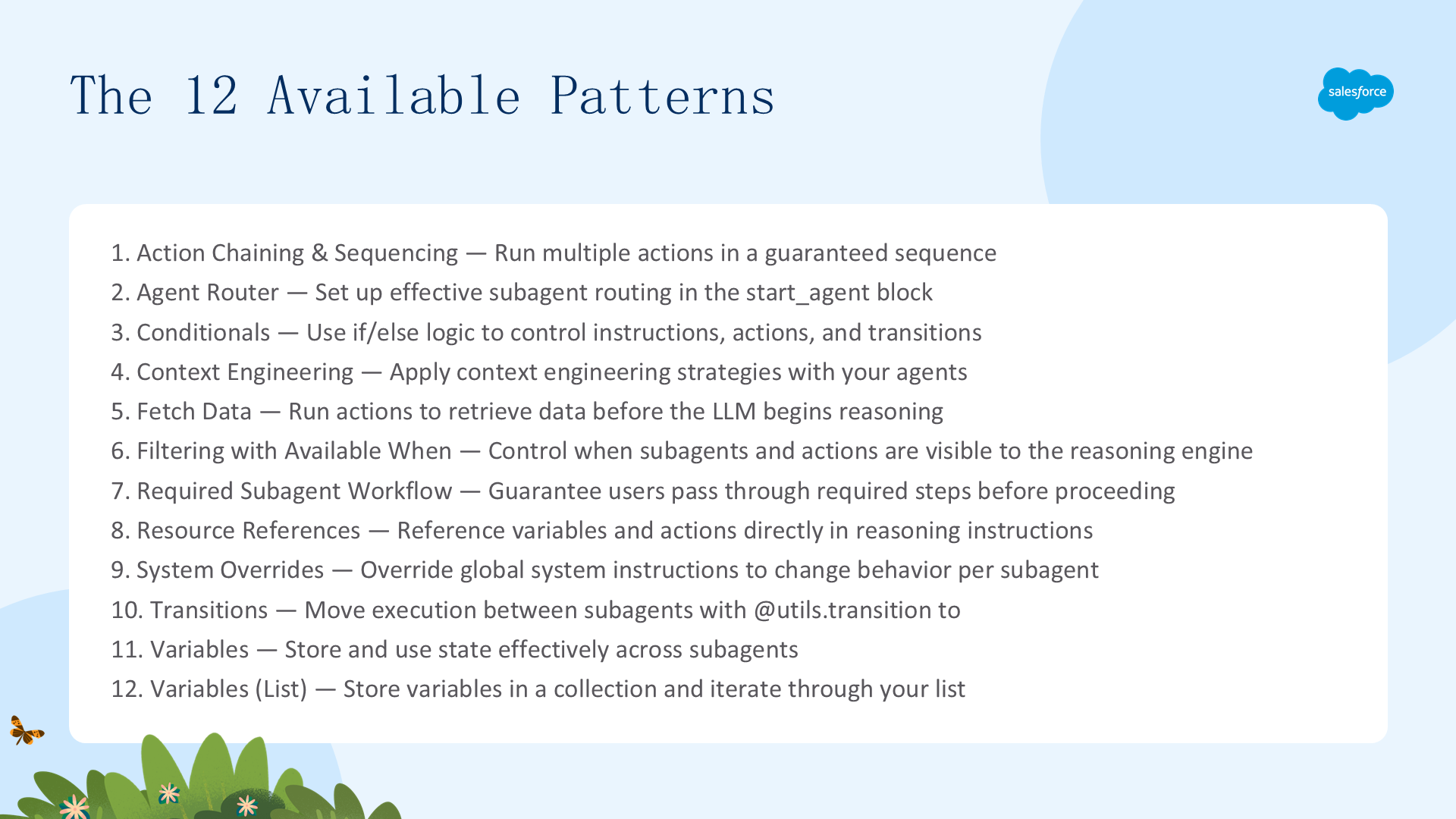
| 模式 | 描述 |
|---|---|
| Action Chaining & Sequencing | 以保证的顺序运行多个动作 |
| Agent Router Strategies | 在 start_agent 块中设置高效的子代理路由 |
| Using Conditionals | 使用 if/else 逻辑控制指令、动作和跳转 |
| Context Engineering | 应用上下文工程策略优化 Agent |
| Fetch Data Before Reasoning | 在 LLM 开始推理之前运行数据检索动作 |
| Filtering with Available When | 控制子代理和动作对推理引擎的可见性 |
| Required Subagent Workflow | 保证用户通过必要步骤后才能继续 |
| Multi-Turn Required Workflows | 通过多轮对话强制执行子代理排序 |
| Resource References | 在推理指令中直接引用变量和动作 |
| System Overrides | 覆盖全局系统指令以按子代理改变行为 |
| Subagent Transitions | 使用 @utils.transition to 在子代理之间移动 |
| Using Variables Effectively | 跨子代理存储和高效使用状态 |
| Using List Variables | 使用列表(集合)变量存储和迭代多个值 |
通用指导原则
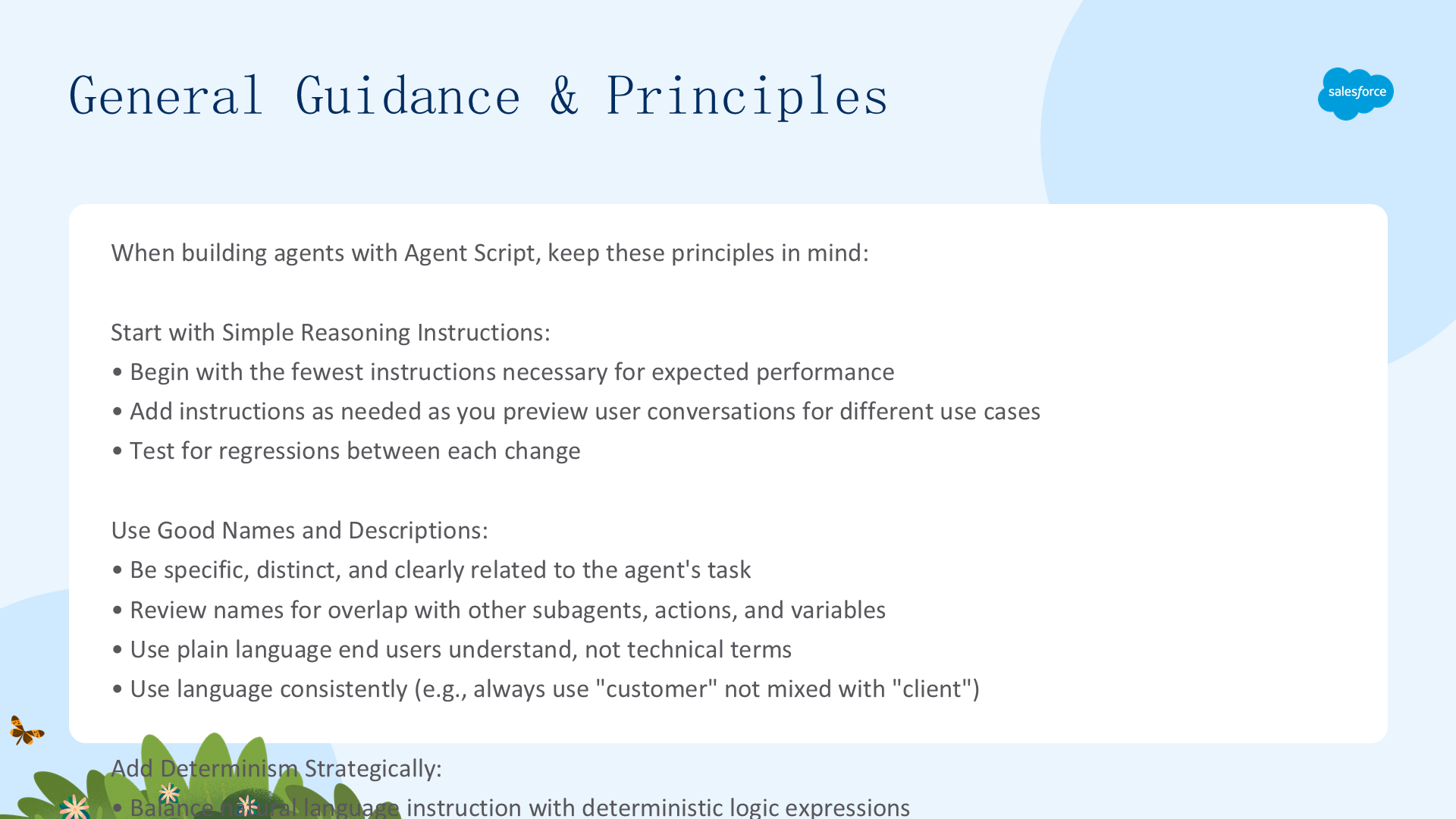
使用 Agent Script 构建 Agent 时,牢记以下原则:
- 从简单的推理指令开始。以最少的必要指令开始让 Agent 按预期工作。预览不同用例的用户对话后按需增量添加指令,每次变更之间回归测试
- 使用好的命名和描述。清晰的名字帮助 Agent 做出更好的决策。
- 好的名称和描述是具体、独特且与 Agent 任务明确相关的
- 审查 Agent 中其他子代理、动作和变量的名称和描述,确保它们独特且不重叠
- 使用最终用户可能使用的自然语言而非技术术语。这让 Agent 更容易将用户问题匹配到相关资源
- 始终使用一致的语言。当语言模糊时,Agent 可能不一致或不正确地应用指令。例如,不要将一个动作命名为"Get Client Info"而另一个命名为"Verify Customer"——在两个地方统一使用"customer"
- 策略性添加确定性。在自然语言指令和确定性逻辑表达式之间取得平衡。为业务工作流添加逻辑来增加可预测行为,同时保留 LLM 处理对话灵活性的能力
- 在推理指令中直接引用资源。使用 @ 提及子代理、动作和变量给 LLM 明确的指导。直接引用资源是给 LLM 的更强信号,增加 Agent 按预期使用资源的概率
模式一:动作链与顺序执行

以保证的顺序运行多个动作。动作链可以通过多种方式实现,取决于何时以及如何执行动作。
应用场景:获取用户订单后立即检查该订单的退货资格。动作顺序确保一个动作可以触发另一个,创建可靠的多步骤工作流,不依赖 LLM 记住多个步骤。
顺序动作 + 链式推理动作
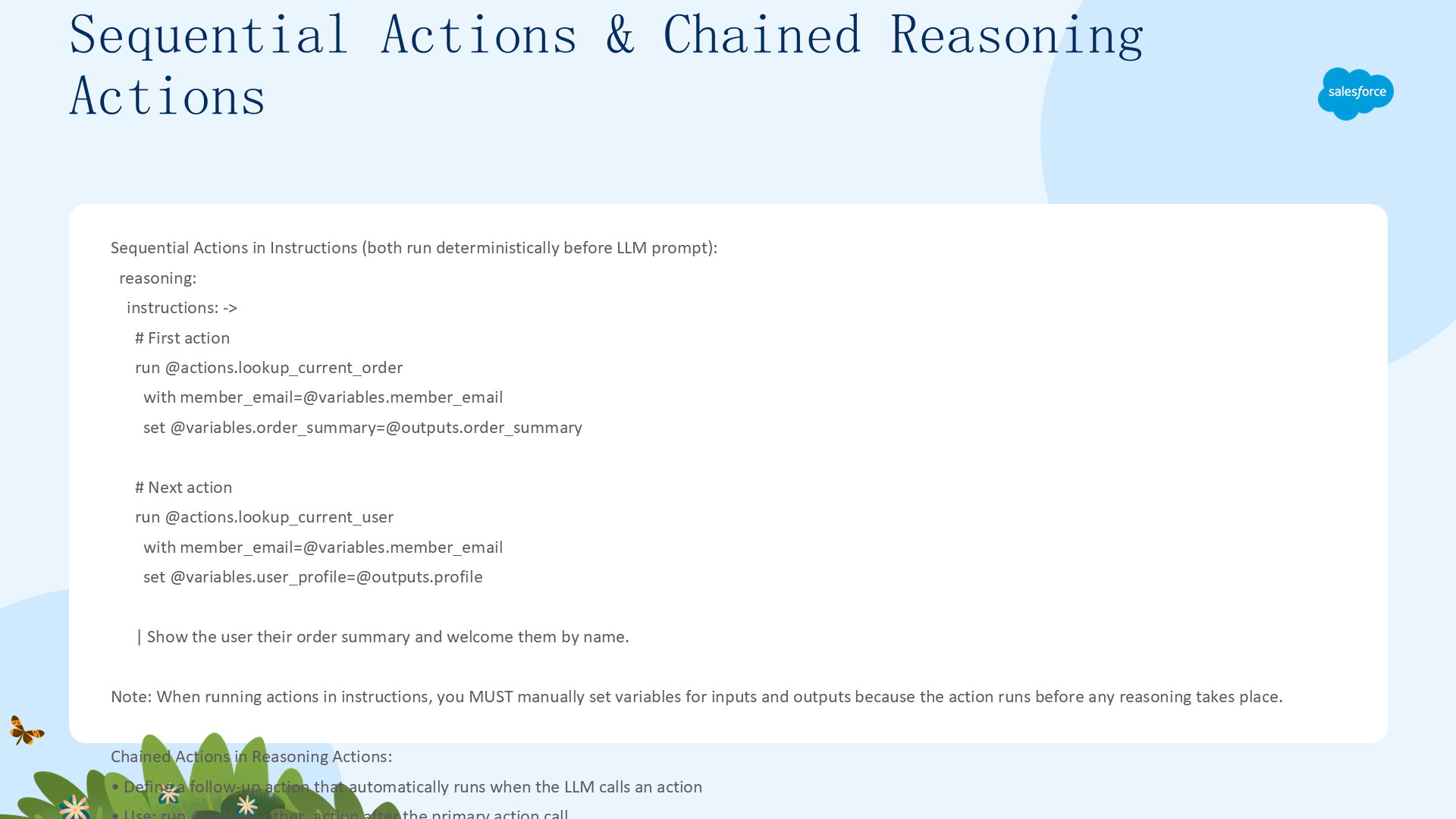
指令中的顺序动作
在推理指令中逐个调用动作。两个动作都在 Prompt 发送给 LLM 之前确定性执行。也可以将一个动作的输出存入变量,作为另一个动作的输入或后续 Prompt 的一部分:
reasoning:
  instructions: ->
    run @actions.lookup_current_order
      with member_email=@variables.member_email
      set @variables.order_summary=@outputs.order_summary

    run @actions.lookup_current_user
      with member_email=@variables.member_email
      set @variables.user_profile=@outputs.profile

| Show the user their order summary and welcome them by name.注意:在指令中运行动作时,必须手动设置变量的输入和输出,因为动作在推理之前运行。
链式推理动作
定义一个后续动作,当 LLM 调用动作时自动运行。用 run 在推理动作定义中链接。每当 LLM 调用 my_action,Agent 自动在之后运行 other_action:
reasoning:
  actions:
    my_action: @actions.my_action
      with foo=@variables.Foo
      set @variables.status = @outputs.status
      run @actions.other_action
        set @variables.some_other_result=@outputs.data
动作+跳转 + 条件链 + 提示
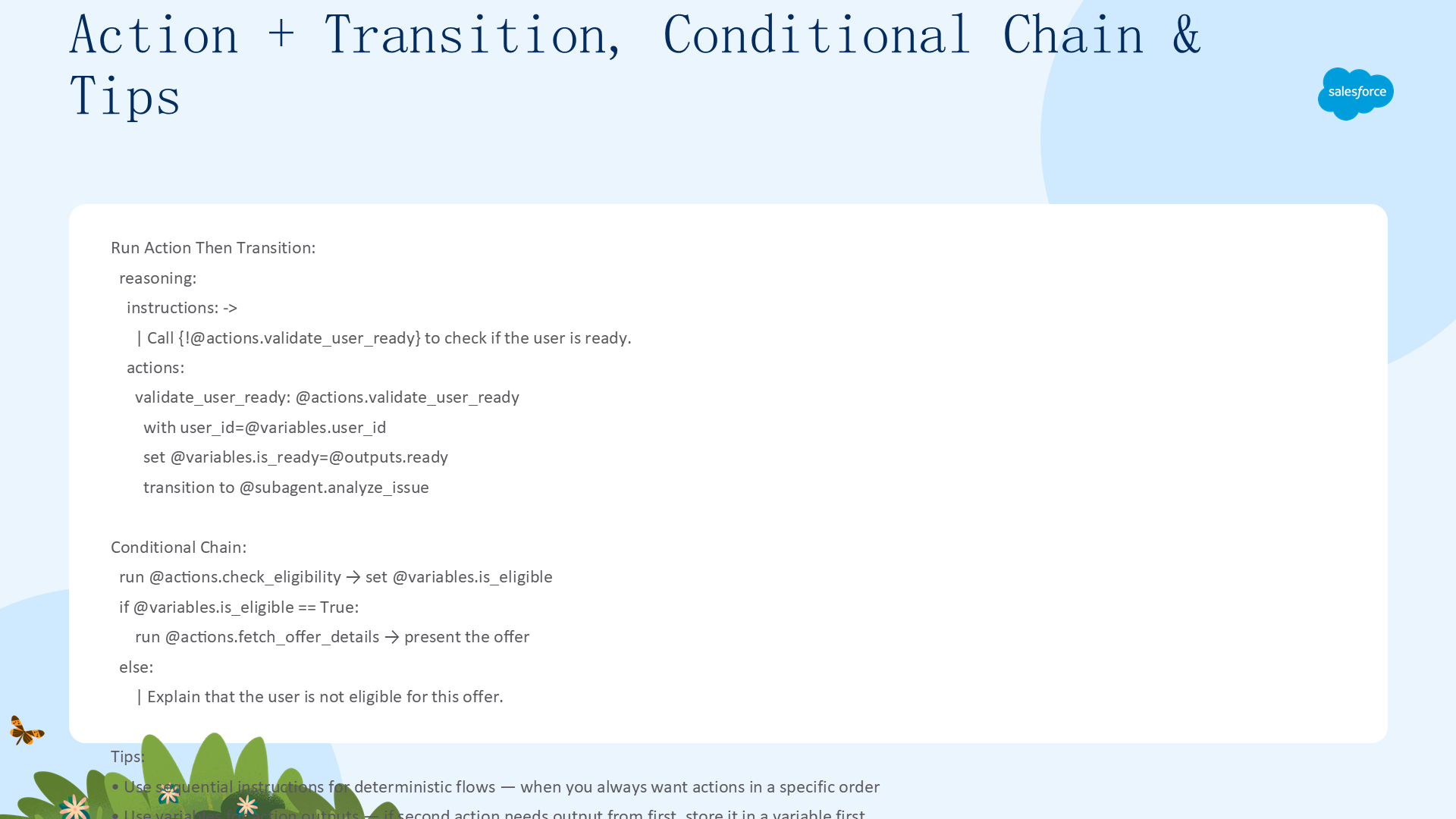
运行动作后跳转
reasoning:
  actions:
    validate_user_ready: @actions.validate_user_ready
      with user_id=@variables.user_id
      set @variables.is_ready=@outputs.ready
      transition to @subagent.analyze_issue
条件动作链
reasoning:
  instructions: ->
    run @actions.check_eligibility
      with user_id=@variables.user_id
      set @variables.is_eligible=@outputs.eligible

    if @variables.is_eligible == True:
      run @actions.fetch_offer_details
        with user_id=@variables.user_id
        set @variables.offer=@outputs.offer
      | Present the offer: {!@variables.offer}
    else:
| Explain that the user is not eligible for this offer.提示:确定性流使用顺序指令;第二个动作需要第一个动作的输出时,用变量存储第一个动作的输出并作为第二个动作的输入。
模式二:Agent Router 策略
Agent Router(即 start_agent 块)是 Agent 的入口点,每次用户发言都从这里开始。它欢迎用户、分类意图、路由到合适的子代理,并根据用户状态控制哪些子代理可用。
基本结构 + 有效描述 + 子代理门控
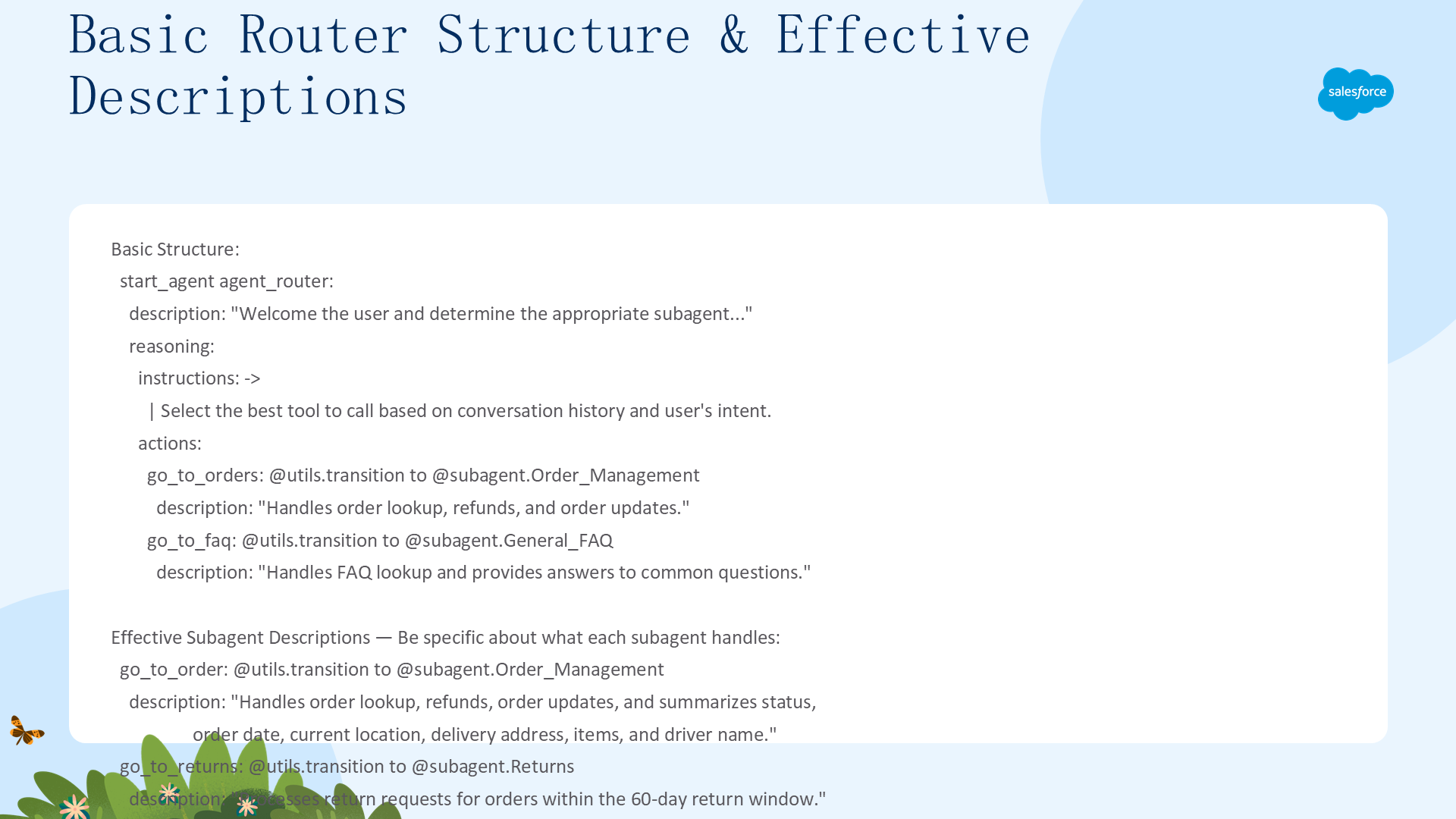
基本 Router 结构
start_agent agent_router:
  description: "Welcome the user and determine the appropriate subagent"
  reasoning:
    instructions: ->
      | Select the best tool to call based on conversation history.
    actions:
      go_to_orders: @utils.transition to @subagent.Order_Management
        description: "Handles order lookup, refunds, and order updates."
      go_to_faq: @utils.transition to @subagent.General_FAQ
        description: "Handles FAQ lookup and common questions."
      go_to_escalation: @utils.transition to @subagent.Escalation
        description: "Escalate to a human representative."
有效描述是关键
描述要具体、独特、详细。好的描述帮助 Agent 选择最佳子代理:
go_to_order: @utils.transition to @subagent.Order_Management
  description: "Handles order lookup, refunds, order updates, and summarizes status, order date, current location, delivery address, items, and driver name."
go_to_returns: @utils.transition to @subagent.Returns
  description: "Processes return requests for orders within the 60-day return window."
子代理门控 + 确定性路由 + 提示
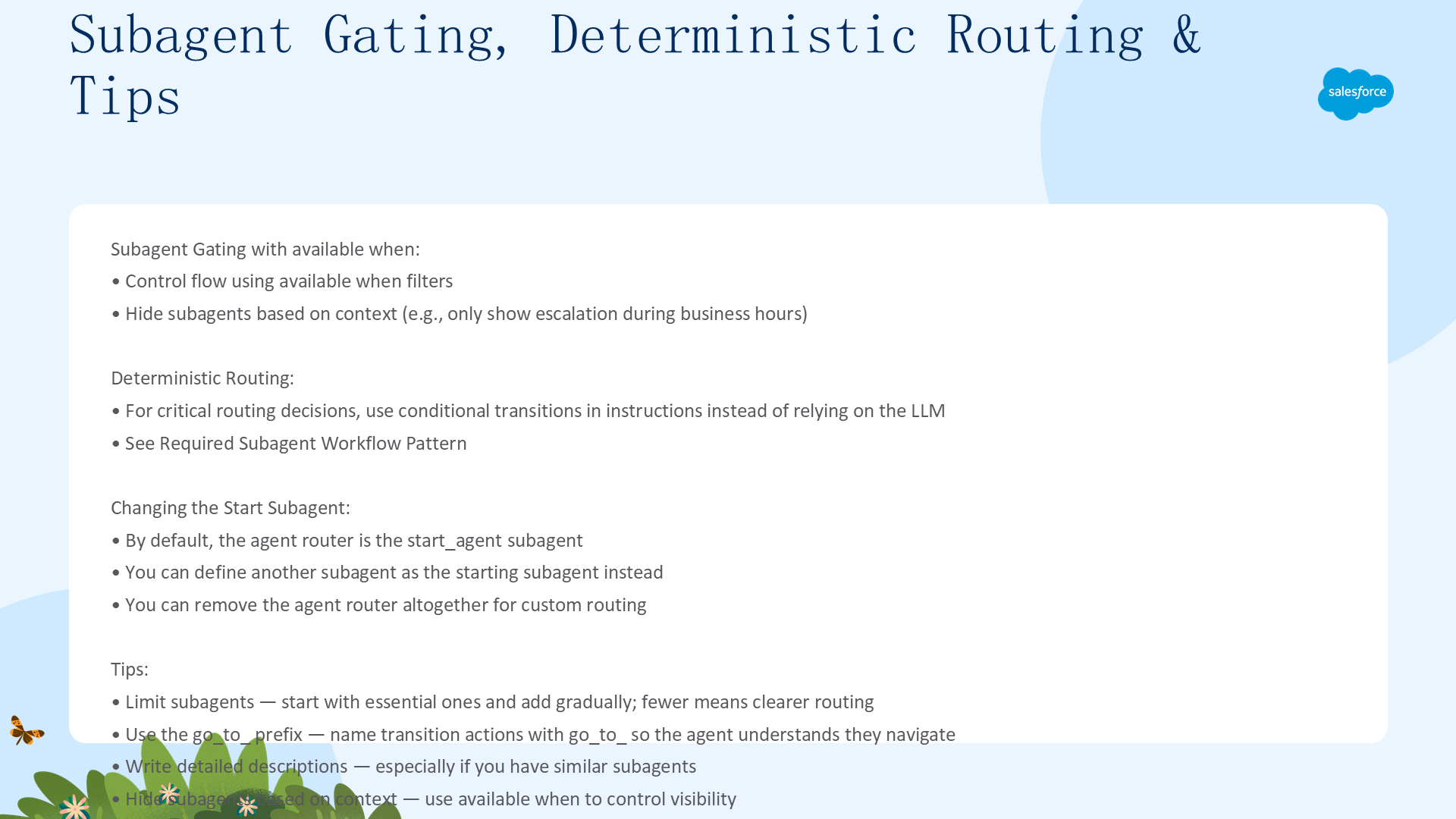
子代理门控(Subagent Gating)
使用 available when 控制子代理可见性。例如未验证用户只能看到身份验证,已验证用户才能访问订单管理。
确定性路由
对于关键路由决策,使用条件跳转而非依赖 LLM 选择。在指令顶部放置条件跳转,确保在 LLM 推理之前强制执行路由。
提示:从核心子代理开始,逐步添加;使用 go_to_ 前缀命名跳转动作;编写详细且独特的描述;使用 available when 基于上下文隐藏子代理;使用条件逻辑保证路由在其他处理之前发生。如果想控制子代理路由方式不同,甚至可以定义另一个子代理作为 start_agent。
模式三:使用条件判断
使用条件判断确定性控制 Agent 行为。条件判断在 Prompt 到达 LLM 之前评估,不依赖 LLM 的解读。
条件指令 + 条件动作 + 条件跳转
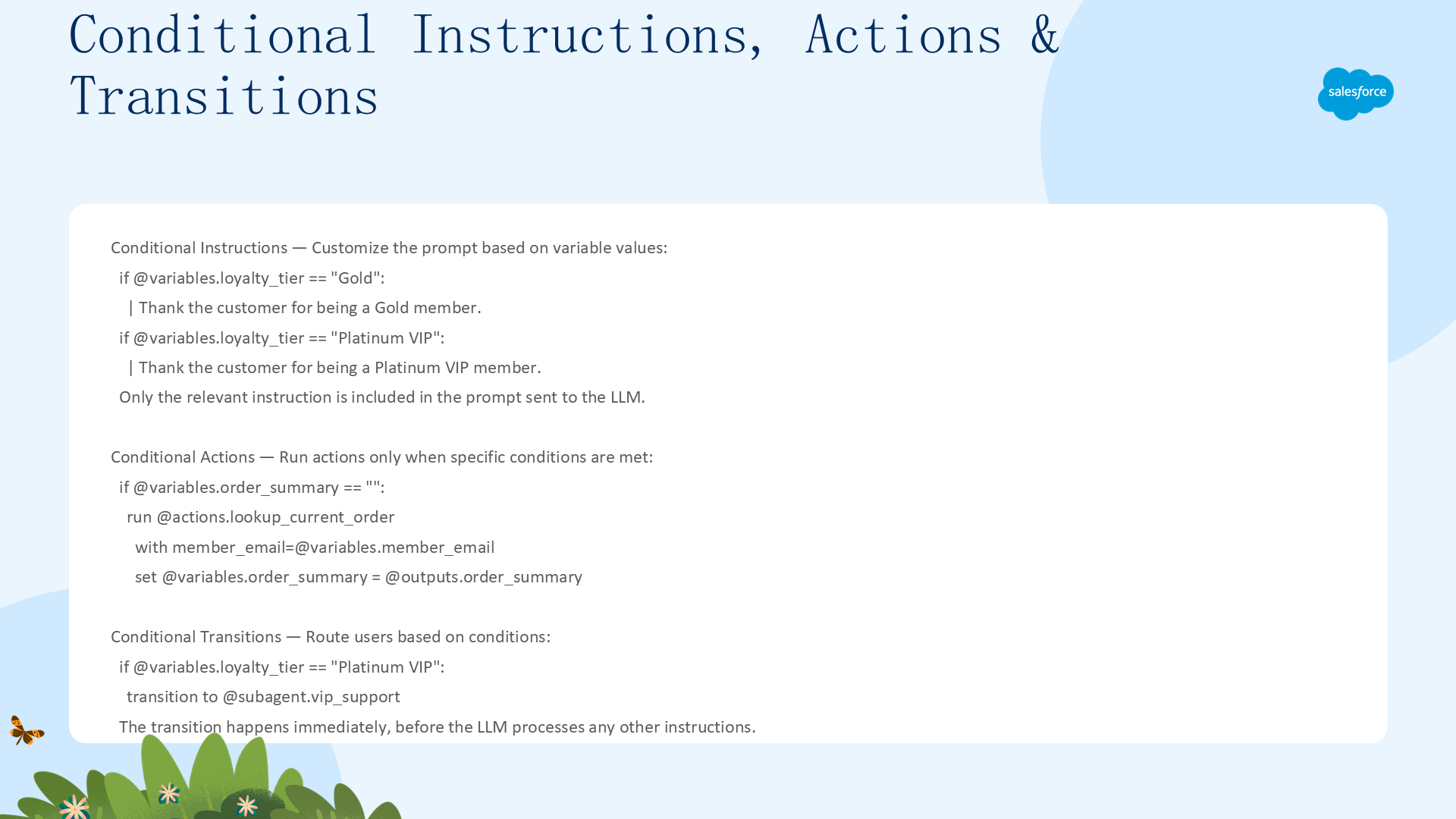
条件指令
根据变量值定制 Prompt。只有满足条件的指令才会被包含在发给 LLM 的 Prompt 中:
reasoning:
  instructions: ->
    | Refer to the user by name {!@variables.member_name}.
    if @variables.loyalty_tier == "Gold":
      | Thank the customer for being a Gold member.
    if @variables.loyalty_tier == "Platinum VIP":
      | Thank the customer for being a Platinum VIP member.
条件动作
只在特定条件满足时运行动作,减少不必要的系统调用:
if @variables.order_summary == "":
  run @actions.lookup_current_order
    with member_email=@variables.member_email
    set @variables.order_summary = @outputs.order_summary
条件跳转
if @variables.loyalty_tier == "Platinum VIP":
  transition to @subagent.vip_support
跳转立即发生,在 LLM 处理任何其他指令之前。
If/Else + 多条件组合 + 提示
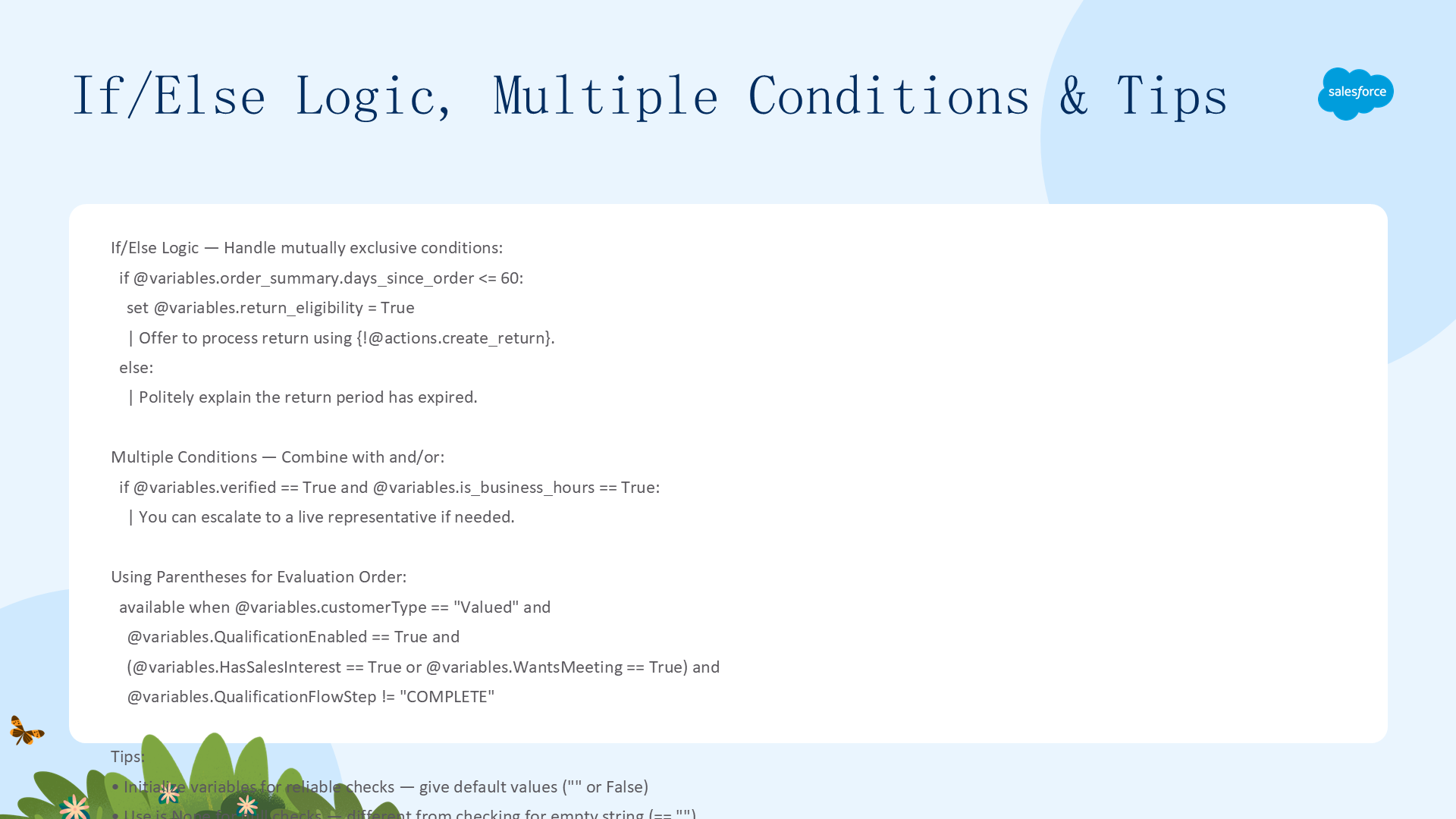
If/Else 逻辑
if @variables.order_summary.days_since_order <= 60:
  set @variables.return_eligibility = True
  | Offer to process return using {!@actions.create_return}.
else:
  | Politely explain the return period has expired.
多条件组合
if @variables.verified == True and @variables.is_business_hours == True:
  | You can escalate to a live representative if needed.

# 使用括号控制求值顺序
available when @variables.customerType == "Valued" and @variables.QualificationEnabled == True and (@variables.HasSalesInterest == True or @variables.WantsMeeting == True) and @variables.QualificationFlowStep != "COMPLETE"提示:给变量设置默认值(如 = "" 或 = False)确保条件检查正确工作;使用 @variables.value is None 检查变量未赋值——这与检查空字符串 == "" 不同,空字符串是有效赋值,而 is None 检查未赋值;使用括号 () 显式分组被求值的条件,例如 available when ... and (... or ...) and ...。
模式四:在推理前获取数据
将动作调用放在推理指令顶部,在 Prompt 构建之前获取数据。确保 LLM 生成响应时能访问到最新、准确的信息。推理指令内的动作在 Prompt 发给 LLM 之前执行。
应用场景:在对话开始前查询用户的当前订单,使 Agent 能用订单状态和个性化推荐来问候用户。
基本模式 + 获取并验证
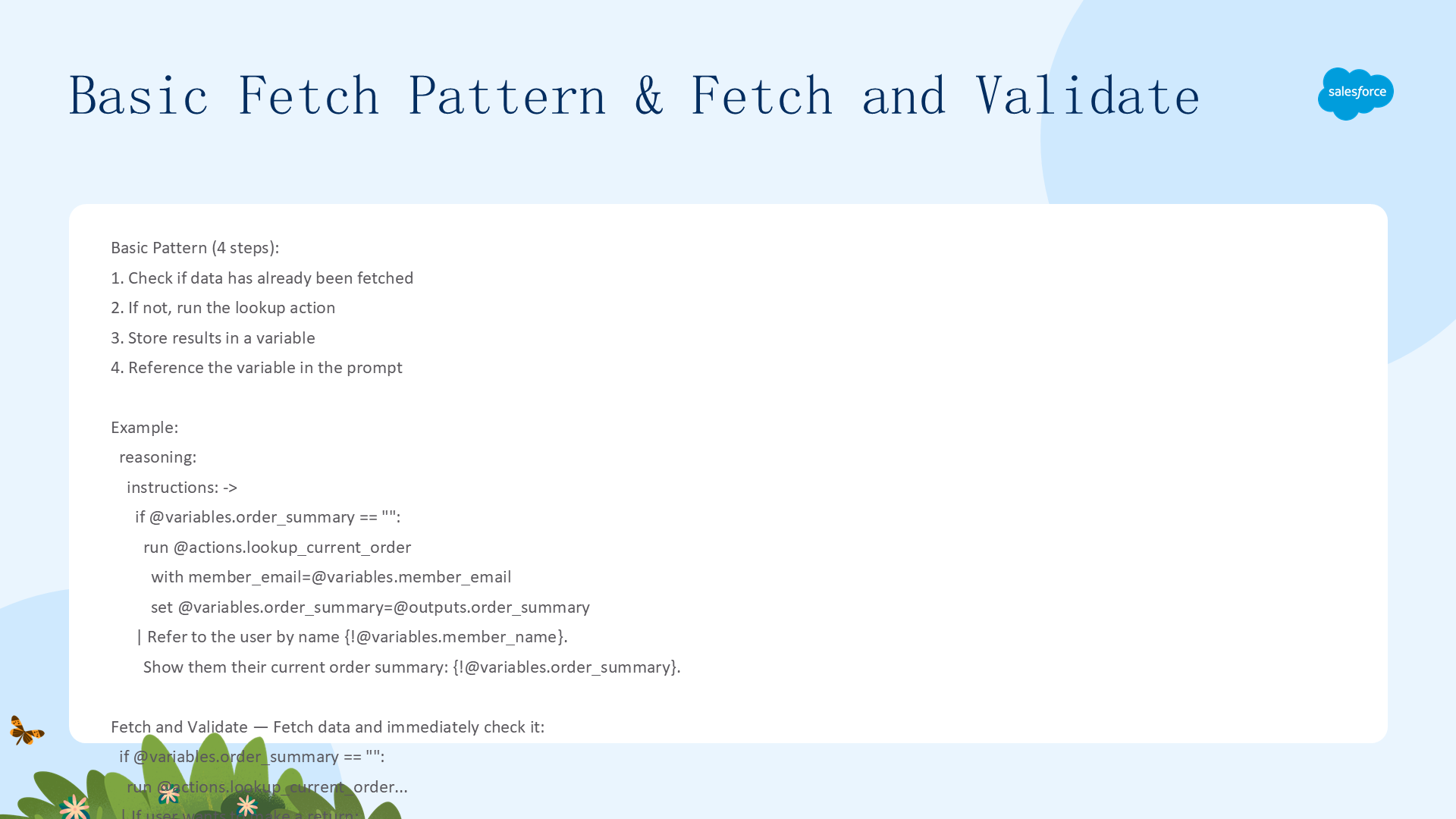
四步模式
reasoning:
  instructions: ->
    # 1. 检查数据是否已获取
    if @variables.order_summary == "":
      # 2. 如果未获取,运行动作
      run @actions.lookup_current_order
        with member_email=@variables.member_email
        # 3. 将结果存入变量
        set @variables.order_summary=@outputs.order_summary

    # 4. 在 Prompt 中引用变量
    | Show them their current order summary: {!@variables.order_summary}.
获取并验证
if @variables.order_summary == "":
  run @actions.lookup_current_order
    with member_email=@variables.member_email
    set @variables.order_summary=@outputs.order_summary

| If user wants to make a return:
if @variables.order_summary.days_since_order <= 60:
  set @variables.return_eligibility = true
  | Offer to process return.
else:
| Politely explain the return period has expired.提示:始终检查数据是否存在后再调用获取动作,避免不必要的动作执行。
模式五:使用过滤器执行业务规则
使用 available when 控制子代理或动作对 LLM 的可见性。当条件不满足时,完全隐藏子代理或动作,简化 LLM 的决策并执行业务规则。
典型场景:仅当订单在退货窗口内且已验证时才启用 create_return 动作。仅在工作时间对已验证客户启用 escalate 子代理。
过滤子代理 + 过滤动作 + 提示
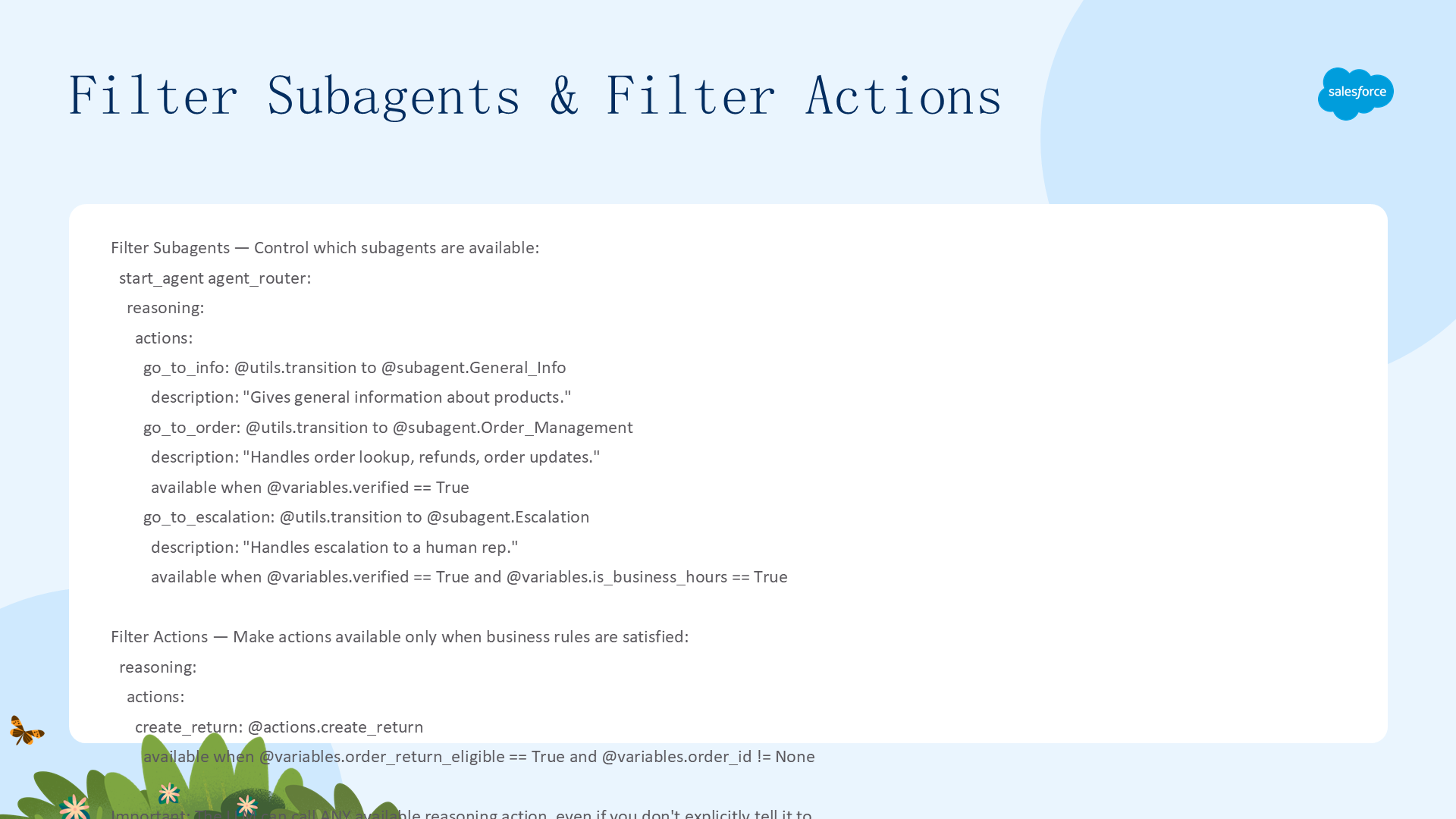
过滤子代理
actions:
  go_to_general: @utils.transition to @subagent.General_Info
      description: "Gives general information."
  go_to_order: @utils.transition to @subagent.Order_Management
      description: "Handles order lookup."
      available when @variables.verified == True
  go_to_escalation: @utils.transition to @subagent.Escalation
      description: "Escalate to a human rep."
      available when @variables.verified == True and @variables.is_business_hours == True
所有用户可访问 General Info;已验证用户可被路由到 Order Management;升级需要验证且工作时间。
过滤动作
actions:
  create_return: @actions.create_return
available when @variables.order_return_eligible == True and @variables.order_id != None注意:LLM 可以调用任何可用的推理动作,即使你没有显式告诉它。不要仅依赖 Prompt 工程来保护业务敏感功能——使用 available when 作为第一道防线,防止客户通过自然语言操纵 Agent 使用未授权的功能。在不使用过滤时,客户可能说服 LLM 使用不被允许的功能,或 LLM 可能在长对话中因上下文漂移而做出推理错误。
提示:用过滤器保护业务敏感功能免受客户操纵;嵌套 and/or 条件时用括号明确求值顺序。
模式六:强制要求的子代理工作流
使用条件跳转保证用户在访问其他功能之前通过必要的步骤。与过滤(移除选项)不同,条件跳转立即强制执行路由行为。
选择正确的方法 + 示例 + 提示
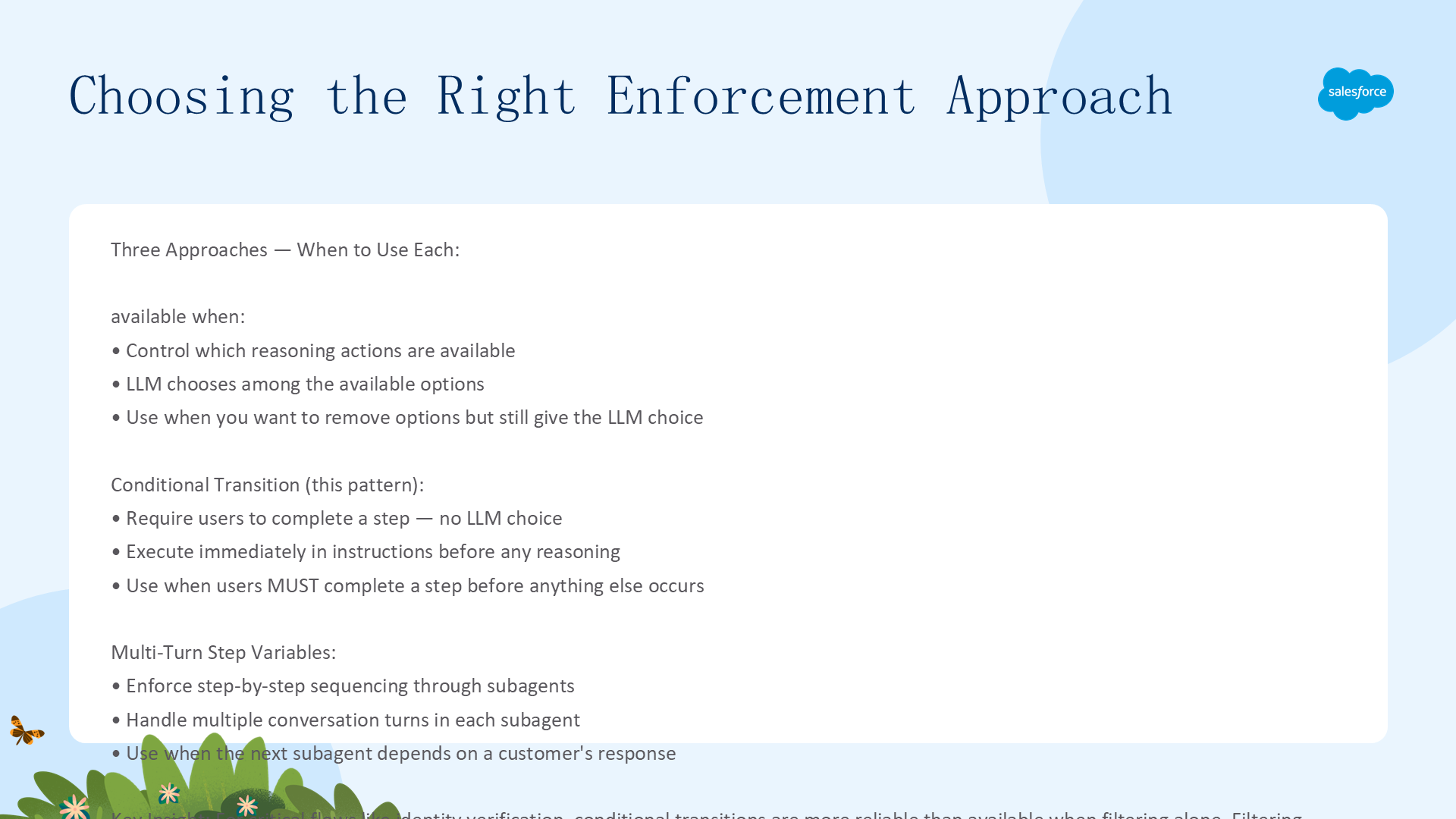
| 方法 | 何时使用 |
|---|---|
available when 过滤 | 控制哪些推理动作可用;LLM 从中选择 |
| 条件跳转 | 要求用户完成某步骤;无 LLM 选择余地 |
| 多轮对话步骤变量 | 强制执行步骤排序,每个子代理处理多轮对话 |
关键区分:对于身份验证等关键流程,指令中的条件跳转比仅使用 available when 过滤更可靠。过滤只是限制选项,但不能强制执行工作流 —— Agent 可能专门选择不需要验证的选项来绕过验证。
示例:全部子代理 + 单个子代理 + 步骤变量
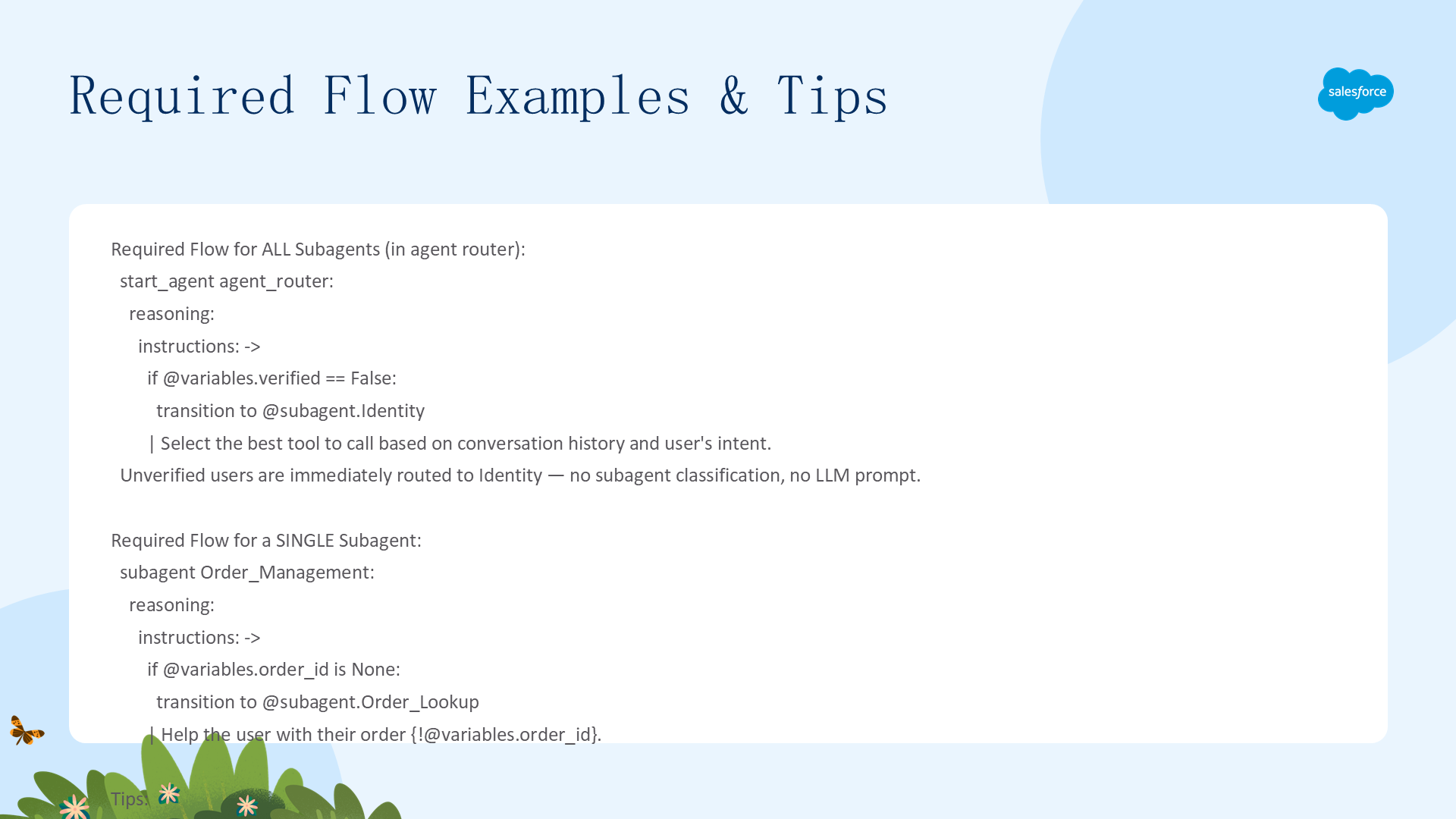
全局强制验证(在 Agent Router 顶部)
start_agent agent_router:
  reasoning:
    instructions: ->
      if @variables.verified == False:
        transition to @subagent.Identity
      | Select the best tool based on conversation history.
    actions:
      go_to_orders: @utils.transition to @subagent.Order_Management
        description: "Handles order lookup, refunds."
未验证用户立即路由到 Identity。验证完成后,变量已设置,流程正常继续。
单子代理前提条件
subagent Order_Management:
  reasoning:
    instructions: ->
      if @variables.order_id is None:
        transition to @subagent.Order_Lookup
| Help the user with their order {!@variables.order_id}.提示:将条件跳转放在指令顶部;使用 go_to_ 前缀命名;使用描述性名称。
模式七:多轮对话中的必需工作流
使用步骤变量(Step Variable)在多轮对话中强制执行子代理排序。Agent Router 根据步骤变量的值选择子代理;子代理内部由 Agent 评估客户回答并设置下一步的步骤变量值。
何时使用:Agent 必须按顺序问一长串问题并验证每个答案;下一个问题取决于前一个答案;一个子代理内可能有多轮对话。仅需单个前置条件门控时使用更简单的强制工作流模式(模式六)。
步骤变量模式 + 面试示例
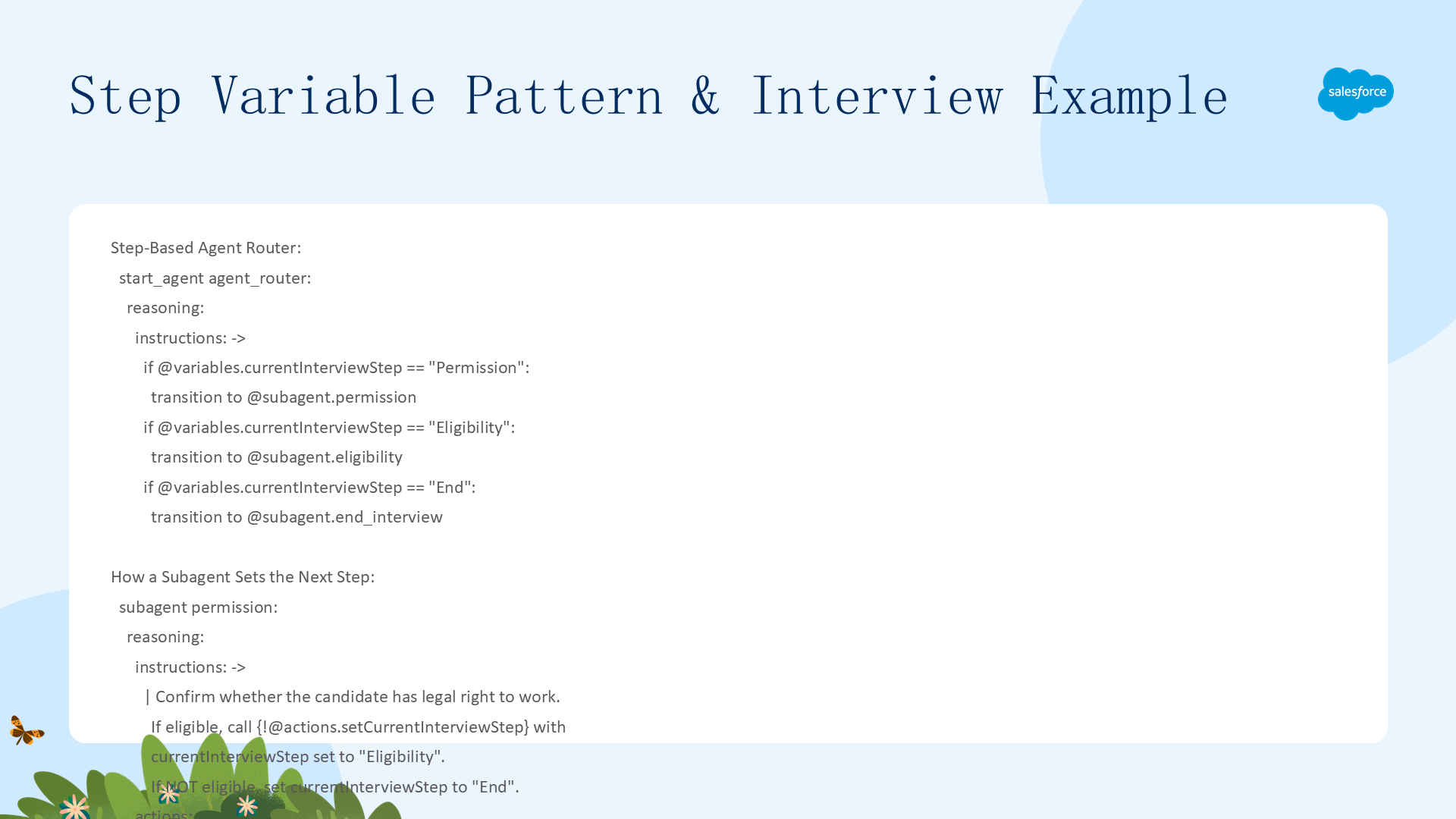
步骤驱动路由
start_agent agent_router:
  reasoning:
    instructions: ->
      if @variables.currentInterviewStep == "Permission":
        transition to @subagent.permission
      if @variables.currentInterviewStep == "Eligibility":
        transition to @subagent.eligibility
      if @variables.currentInterviewStep == "End":
        transition to @subagent.end_interview
子代理控制下一步
subagent permission:
  reasoning:
    instructions: ->
      | Confirm whether the candidate has the legal right to work.
        If eligible, call {!@actions.setCurrentInterviewStep}
        with currentInterviewStep set to "Eligibility".
        If NOT eligible, set currentInterviewStep to "End".
    actions:
      setCurrentInterviewStep: @utils.setVariables
with currentInterviewStep = ...提示:每个子代理只负责验证一个答案;使用清晰的步骤名(permission、eligibility、availability);让子代理自行决定何时答案满意并推进。
模式八:在推理指令中直接引用资源
在推理指令的 Prompt 文本中直接引用子代理、动作和变量。使用 {!@} 语法给 LLM 明确的指导,增加 LLM 选择正确资源的概率。
引用语法 + 综合示例
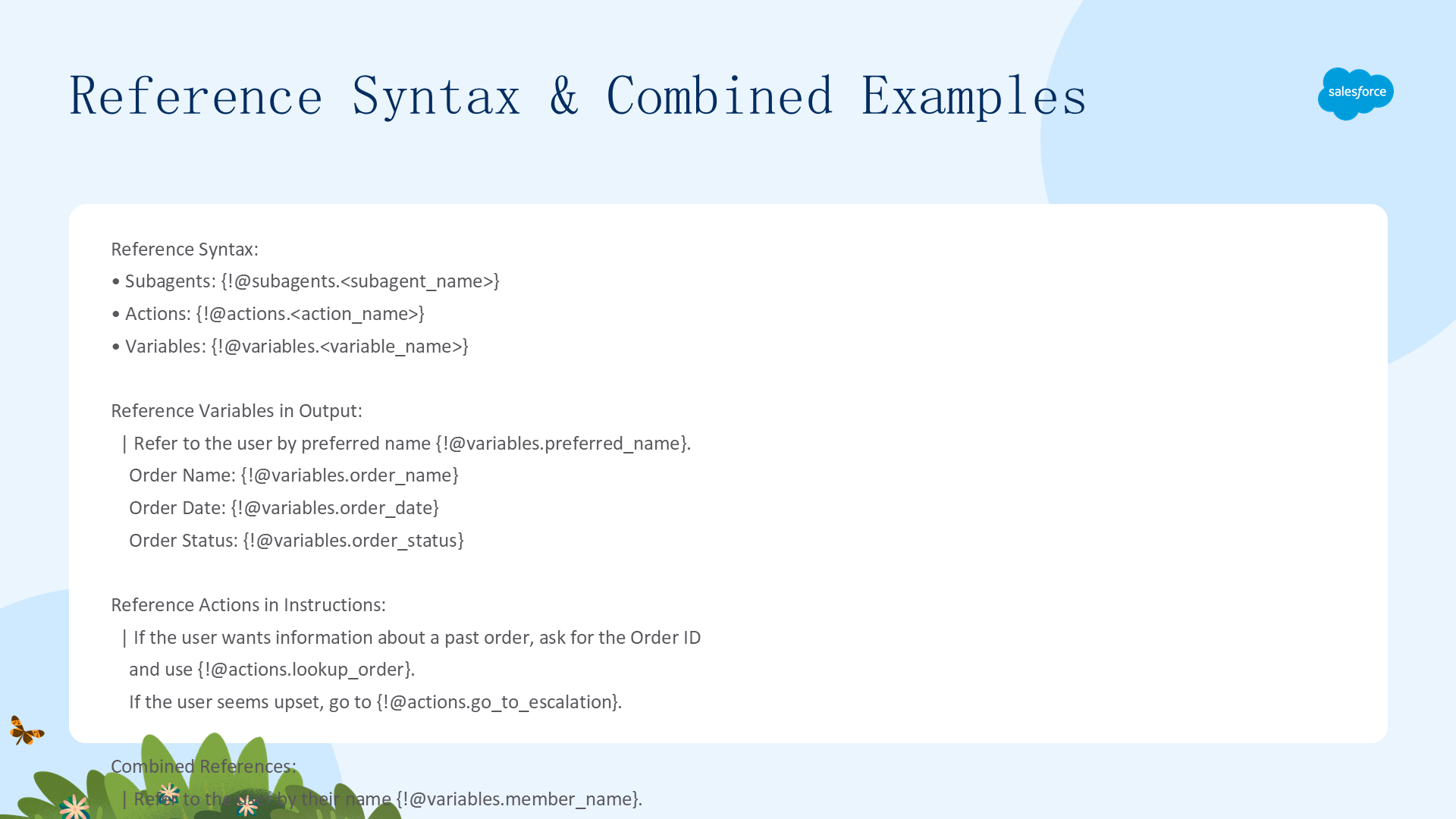
三种引用语法
- 子代理:
{!@subagents.<name>} - 动作:
{!@actions.<name>} - 变量:
{!@variables.<name>}
综合示例
reasoning:
  instructions: ->
    | Refer to the user by name {!@variables.member_name}.
      Show their current order summary: {!@variables.order_summary}
      If the user wants to make a return, confirm their order ID and
      call {!@actions.create_return}. If returns are not eligible
      ({!@variables.order_return_eligible} is False), explain why.
      If they need more help, go to {!@actions.go_to_escalation}.
条件中的引用
if @variables.loyalty_tier == "Gold":
  | Thank the customer for being a Gold member.
    Their current points balance is {!@variables.points_balance}.
if @variables.loyalty_tier == "Platinum VIP":
| Welcome back, valued Platinum VIP member {!@variables.member_name}!提示:当你有大量动作时,添加引用帮助 Agent 选择正确的一个。直接引用是给 LLM 的更强信号。
模式九:使用指令覆盖避免冲突
在特定子代理中覆盖系统级指令(UI 中称为 Agent 级指令),动态改变 Agent 的行为和角色。当 Agent 级系统指令与子代理级推理指令矛盾时,Agent 可能会卡住或行为异常 —— 系统覆盖通过显式替换来解决此问题。
应用场景:活动策划 Agent 通常避免建议酒精饮品,但在成人派对子代理中覆盖系统指令以允许鸡尾酒推荐。或在不同子代理间切换技术专家/创意头脑风暴的角色。
指令层级 + 多角色创建
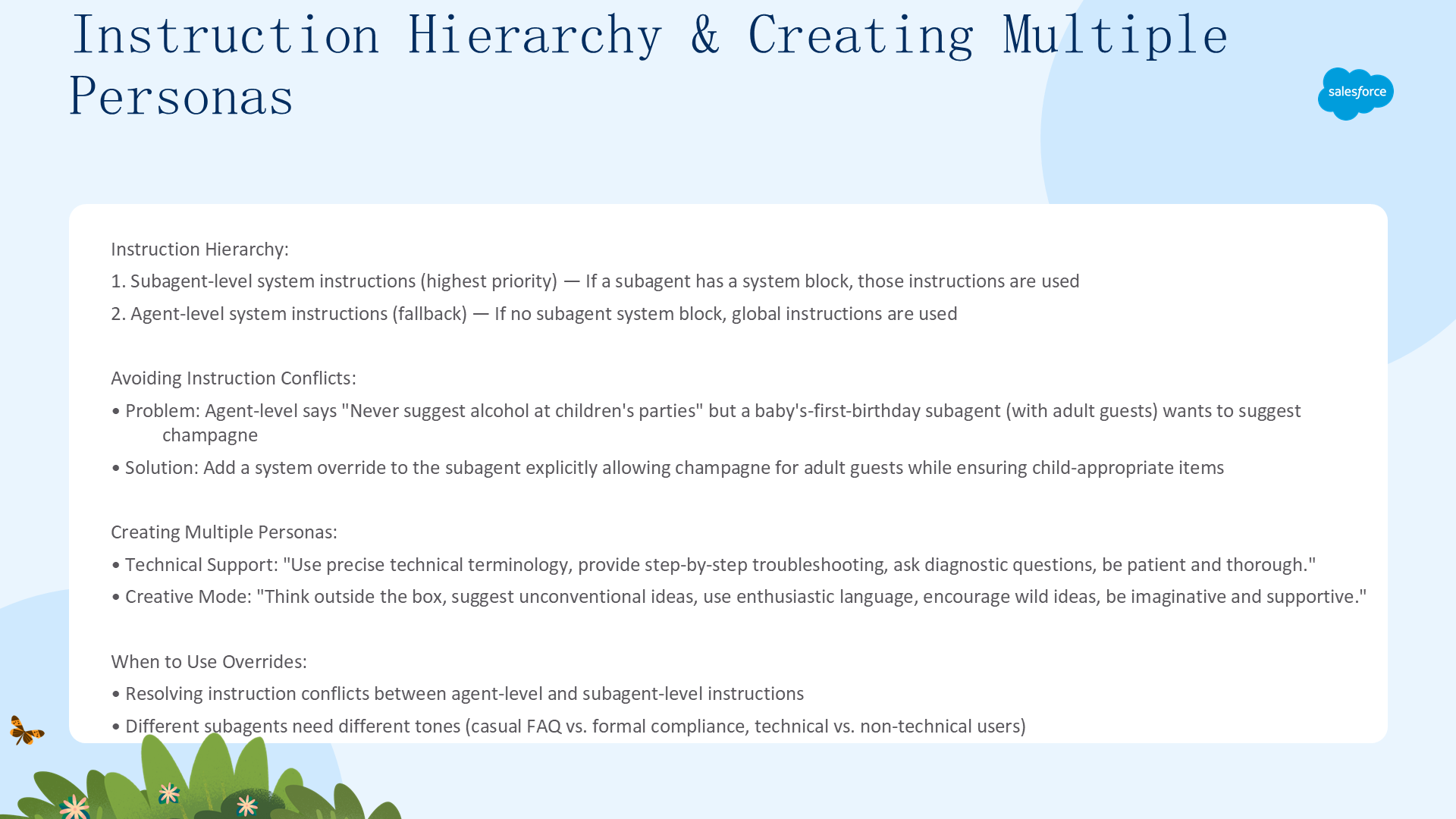
指令层级(优先级从高到低)
- 子代理级 system.instructions(最高优先级) — 子代理有 system 块时使用
- Agent 级 system.instructions(回退) — 子代理无 system 块时使用全局指令
解决冲突示例
# Agent 级(全局)
system:
  instructions: "NEVER suggest alcoholic beverages for children's parties."

# 子代理覆盖
subagent baby_first_birthday:
  system:
    instructions: "You may suggest beverages including champagne for adult guests, while ensuring child-appropriate food."
创建多角色(技术专家 vs 创意模式)
subagent technical:
  system:
    instructions: "You are a technical support specialist. Use precise technical terminology, provide step-by-step troubleshooting, ask diagnostic questions."

subagent creative:
  system:
    instructions: "You are a creative brainstorming partner. Think outside the box, suggest unconventional ideas, use enthusiastic language."
模式十:子代理跳转
使用 @utils.transition to 将执行从一个子代理移动到另一个。跳转是单向的——发生时 Agentforce 丢弃当前子代理的所有 Prompt,处理新子代理。
推理跳转 vs 确定性跳转
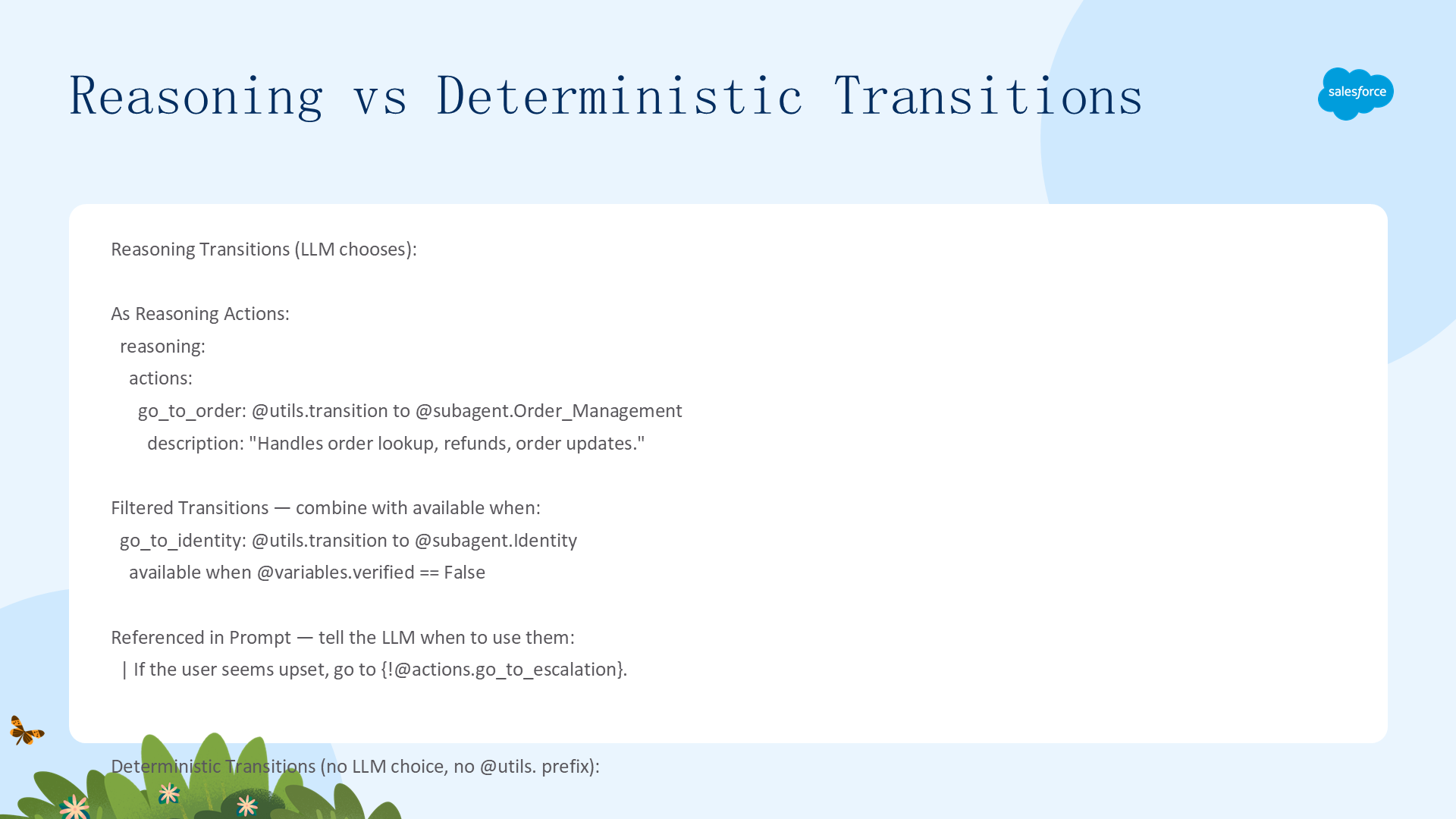
推理跳转(LLM 选择)vs 确定性跳转(脚本确定)的关键区别:
| 类型 | 方式 | 语法 | 使用场景 |
|---|---|---|---|
| 推理动作跳转 | LLM 选择 | actions 中定义 @utils.transition to | Agent Router 路由 |
| 过滤跳转 | LLM 选择(受限) | + available when | 按状态控制可见性 |
| 条件跳转 | 确定性 | 指令中 transition to(无 @utils. 前缀) | 强制工作流 |
| 动作后跳转 | 确定性 | 动作定义中 + transition to | 动作完成后自动路由 |
推理跳转(暴露为 LLM 工具)
actions:
  go_to_escalation: @utils.transition to @subagent.Escalation
    description: "Escalate if requested or needed."
确定性跳转(条件触发)
if @variables.loyalty_tier == "Platinum VIP":
transition to @subagent.vip_support # 无 @utils. 前缀!提示:确定性跳转慎用,仅在需要保证路由时使用;置顶条件跳转以减少不必要的延迟;避免创建跳转循环(A→B 且 B→A 无限循环)。
模式十一:有效使用变量
变量跨子代理和对话轮次存储 Agent 当前状态。策略性使用变量来跟踪重要信息,但避免过度存储每一条数据。典型用途包括:存储值供条件判断复用、存储动作输出、available when 条件检查。
初始化 + 存储 + 共享 + Slot Filling
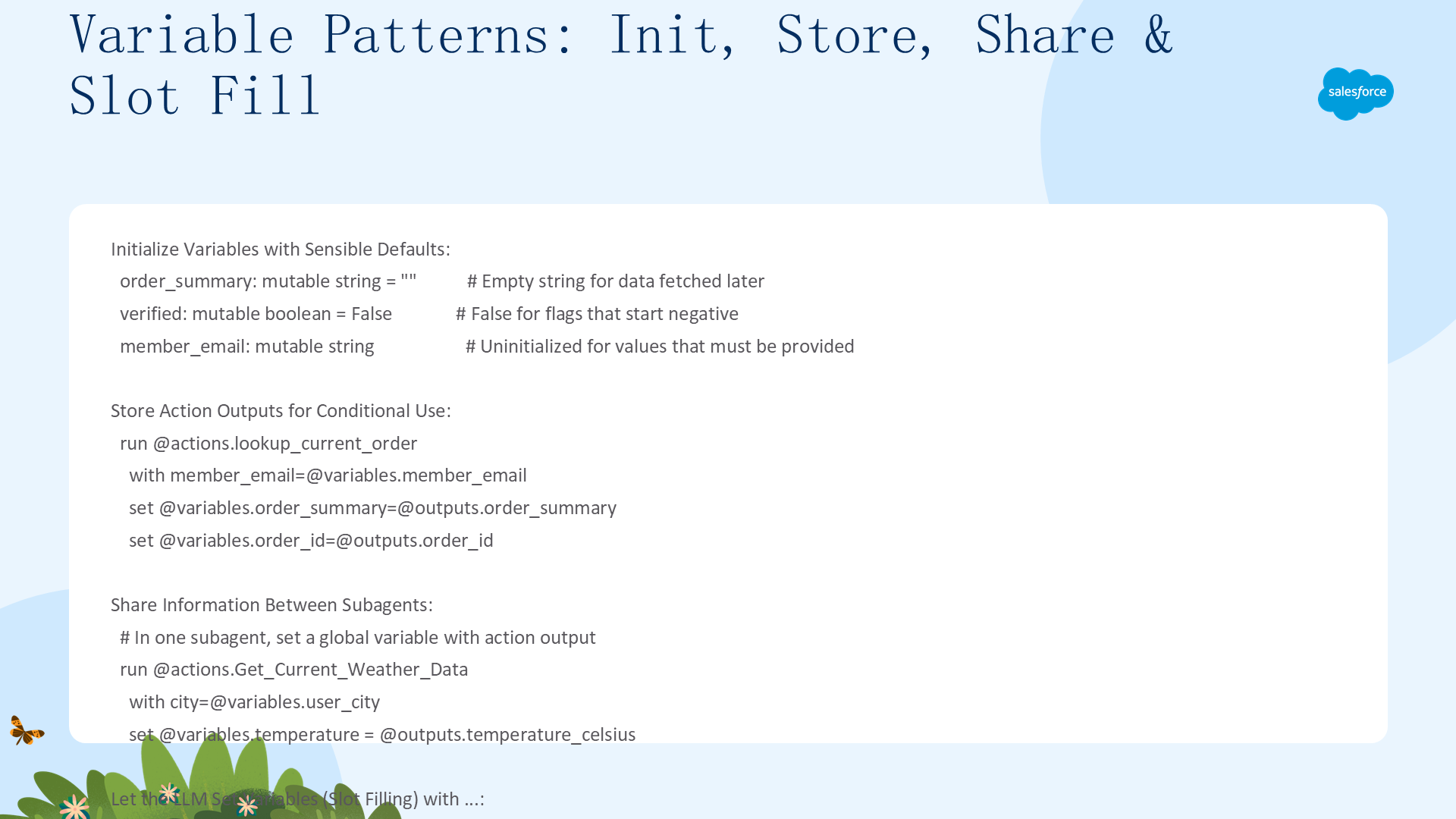
初始化变量
variables:
  order_summary: mutable string = ""    # 后续获取的文本
  verified: mutable boolean = False     # 初始为负的标志
  member_email: mutable string          # 必须提供的值,不初始化
好的变量描述
is_business_hours: mutable boolean = False
  description: "Whether it is business hours. Used to determine if escalation is available."
loyalty_tier: mutable string
  description: "The customer's loyalty tier (Standard, Gold, Platinum VIP). Used for personalized greetings."
子代理间共享信息
run @actions.Get_Current_Weather_Data
  with city=@variables.user_city
  set @variables.temperature = @outputs.temperature_celsius
# temperature 现在对所有子代理可用
Slot Filling(LLM 设置变量值)
使用 ... 指示 LLM 用推理来设置变量值。LLM 可以询问用户姓名,然后使用 capture_user_info 工具设置这些变量的值。这种模式称为 Slot Filling。对于简单工作流,LLM 可以仅凭动作的描述和名称自行判断调用哪个动作;在本示例中显式引用 {!@capture_user_info} 确保 LLM 存储用户信息:
注意:Slot-filling 可用于顶层动作输入(由 LLM 调用),但不适用于链式动作输入(链式动作是确定性运行的)。
提示:命名清晰(order_return_eligible 而非 flag1);推理指令中运行动作时必须手动为输入输出设置变量;推理动作中使用变量作为动作输入要谨慎——指定太多输入变量可能导致 Agent 选择动作不一致,仅在必要时基于测试结果指定;需要用于条件表达式或另一个动作时必须存储动作输出。
actions:
  capture_user_info: @utils.setVariables
    with first_name = ...
    with last_name = ...
    description: "Set the user's name as variables"
模式十二:使用列表变量

列表变量(集合变量)允许 Agent 存储和迭代一组值。可存储任何支持的类型(字符串、布尔值、数字、对象)。使用 [index] 引用列表项,索引从 0 开始。
应用场景:面试问题列表、搜索结果、跟踪收集进度。需要逐项处理时配对索引变量。
声明、引用与迭代
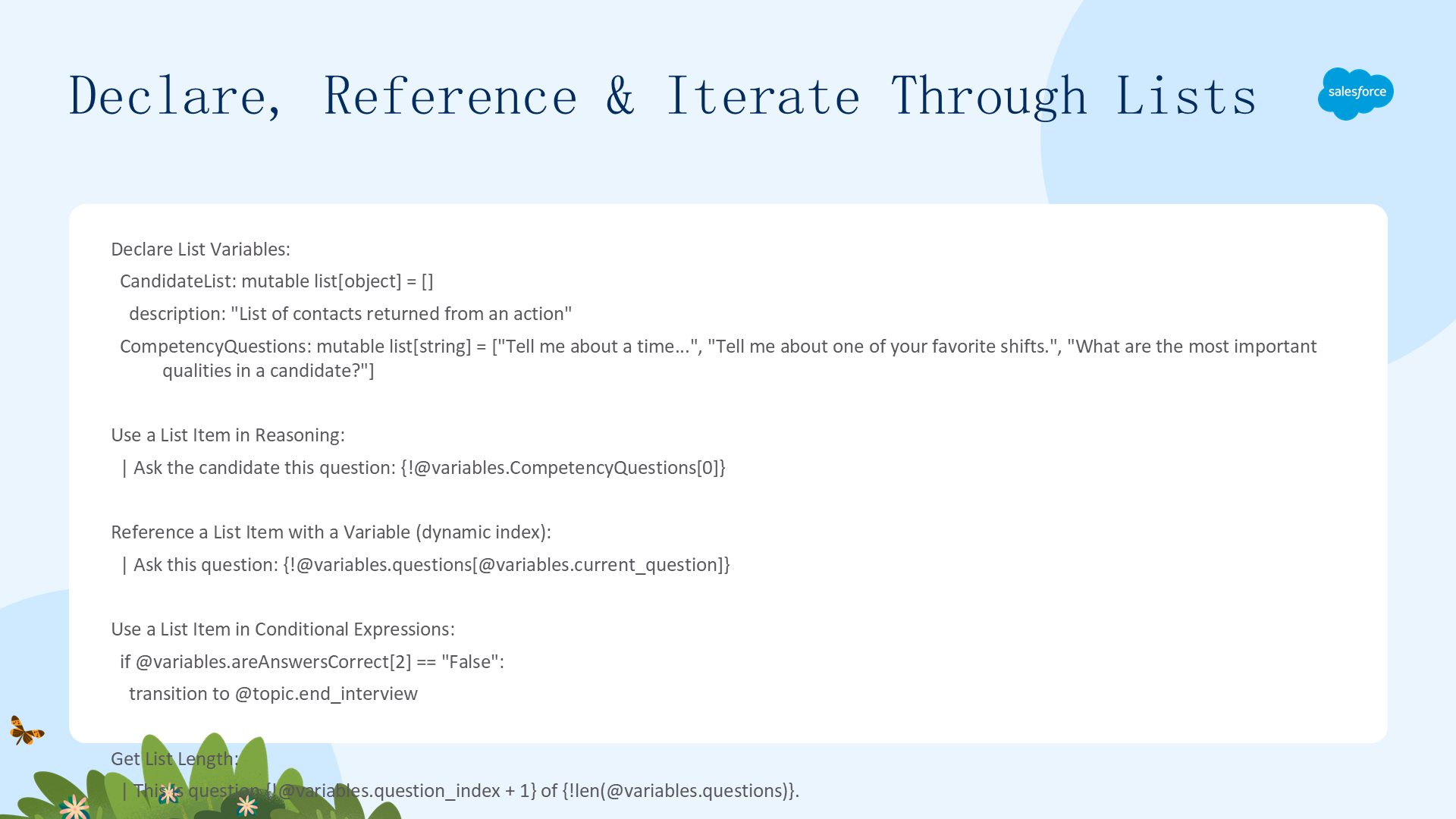
声明列表
variables:
  CandidateList: mutable list[object] = []
      description: "List of contacts returned from an action"
  CompetencyQuestions: mutable list[string] = ["Tell me about a time you disagreed with a coworker.", "Tell me about one of your favorite shifts."]
      description: "List of competency questions"
引用列表项
# 直接索引:第一个问题
| Ask: {!@variables.CompetencyQuestions[0]}

# 用变量索引
| Ask: {!@variables.questions[@variables.current_question]}

# 条件中使用
if @variables.areAnswersCorrect[2] == "False":
  transition to @topic.end_interview
获取列表长度
| This is question {!@variables.question_index + 1} of {!len(@variables.questions)}.迭代列表(无 for 循环)
Agent Script 没有 for 循环。通过在每个对话轮次后递增索引变量来模拟迭代:
variables:
  questions: mutable list[object] = []
  question_index: mutable number = 0
  is_GetQuestions_run: mutable boolean = False

topic ask_questions:
  reasoning:
    instructions: ->
      if @variables.is_GetQuestions_run == False:
        run @actions.Get_Questions
          set @variables.questions = @outputs.AllScreeningQuestions
          set @variables.question_index = 0
          set @variables.is_GetQuestions_run = True
      | Ask: {!@variables.questions[@variables.question_index]}
Agent 记录答案后递增 question_index。当索引到达列表长度时跳转到下一个子代理。
掌握这 12 个模式是成为 Agent Script 专家的关键。建议按照"理解模式 → 复制示例 → 修改适配 → 测试验证"的流程逐个实践。